
 NuFace Hospital on February 14, 2026.
Most dentists will see jaw pain walk through the door at some point. Sometimes it is subtle. A patient mentions stiffness while chewing or a dull ache near the ear. Other times it is obvious. Limited opening. Audible clicking. A face that looks tired before the appointment even starts.
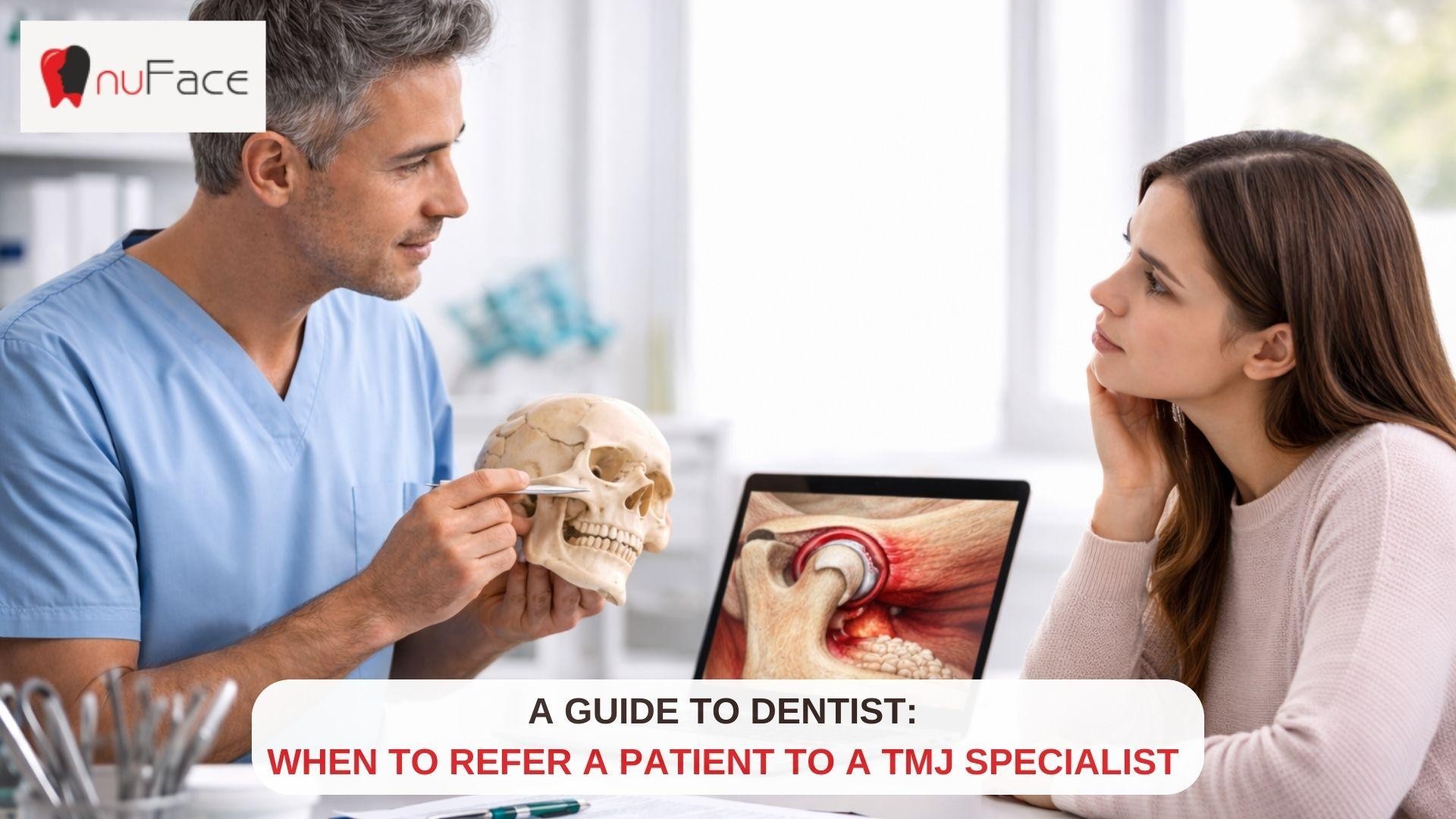
The tricky part is knowing when routine care and conservative management are enough, and when it is time to bring in a TMJ specialist. TMJ conditions sit in that gray zone where dental, muscular, and joint issues overlap. Referral timing matters more than many realize. In this blog post, Dr Nehal Patel, one of the most renowned TMJ specialists in India, points out the exact situations when a dentist should pass on the baton to specialists.
Understanding What Crosses the Line
Many TMJ symptoms respond well to splints, physical therapy, habit changes, or short term medication. Those approaches should almost always come first. But not every joint problem wants to cooperate.
When pain becomes persistent, severe, or progressive, it is often a sign that the joint itself is no longer functioning normally. Patients may describe a deep aching sensation that feels different from muscle soreness. Some will say it feels like the joint is grinding or catching. Others report pain that radiates into the ear, temple, or neck and never really shuts off.
If symptoms linger for months despite well managed conservative care, it is time to pause, reassess and bring in a TMJ arthroscopy specialist in India. At that point, continuing the same approach rarely changes the outcome.
Red Flags That Should Not Be Ignored
There are moments when referral should feel less like an option and more like a responsibility.
One is a limited mouth opening that keeps getting worse. If a patient struggles to open beyond two fingers and the range continues to shrink, something structural may be happening inside the joint.
Another is locking, whether open or closed. Intermittent locking can sometimes improve, but frequent episodes that disrupt eating or speaking deserve specialist evaluation.
Swelling around the joint, especially when paired with heat or redness, is another sign to take seriously. Dr Nehal Patel, a TMJ surgery specialist in India, says, this often points to active inflammation or degeneration rather than simple muscle tension.
And then there is pain that interferes with daily life. If a patient cannot sleep, eat normally, or work comfortably because of jaw pain, waiting longer rarely helps.
When Imaging Changes the Conversation
Advanced imaging often clarifies what clinical exams cannot. MRI and CT scans can reveal disc displacement, joint erosion, adhesions, or advanced degeneration.
If imaging shows significant internal derangement, conservative care may no longer match the problem. That is when a TMJ specialist adds real value. They are trained to assess whether minimally invasive procedures could restore joint function or whether replacement is the more realistic path.
Ignoring imaging findings and pushing ahead with basic care can frustrate both clinician and patient.
Arthroscopy Versus Joint Replacement
Not every referral means surgery, and not every surgery means replacement. Arthroscopy is often used when the joint is damaged but still salvageable. It allows direct visualization, lavage, and release of adhesions with relatively low morbidity.
Joint replacement enters the picture when the joint is beyond repair. Severe osteoarthritis, ankylosis, failed prior surgeries, or congenital deformities often fall into this category. At that stage, replacing the joint can dramatically improve quality of life.
Dentists do not need to decide which path is right. The referral itself opens the door to expert assessment and shared decision making.
Timing Is More Important Than Perfection
Many dentists worry about referring too early. In practice, the bigger issue is usually referring too late. Chronic joint disease can lead to muscle compensation, bite changes, and even psychological distress over time.
Dr Nehal Patel has performed numerous TMJ surgeries in India. He is familiar with such situations and explains that, “Early referral does not commit a patient to surgery. It simply expands their options. Patients often appreciate knowing that there is a clear plan if conservative care stops working.
How to Talk to Patients About Referral
Patients can feel anxious when they hear the word specialist. Keep the language grounded and honest. Explain that TMJ conditions vary widely and that complex joints sometimes need advanced evaluation.
Framing the referral as a second set of experienced eyes helps. Emphasize collaboration rather than handoff. Patients respond well when they sense their care team is aligned.
The Practical Takeaway
As a dentist, you are often the first professional to spot TMJ dysfunction. Trust that instinct. If symptoms persist, worsen, or limit daily life despite thoughtful care, referring your patient to a TMJ specialist in India is not a failure. It is good clinical judgment.
Your role is not to solve every TMJ case alone. It is to recognize when the joint needs more than routine tools can offer and to guide your patient to the right specialist at the right time.
Reference
Internal Derangements of the Temporomandibular Joint – Oral and Maxillofacial Surgery for the Clinician, Association of Oral and Maxillofacial Surgeons of India (AOMSI), Springer (open access).